

This page was translated from Dutch with AI.
Automating, upgrading or innovating: where does your AI idea sit?
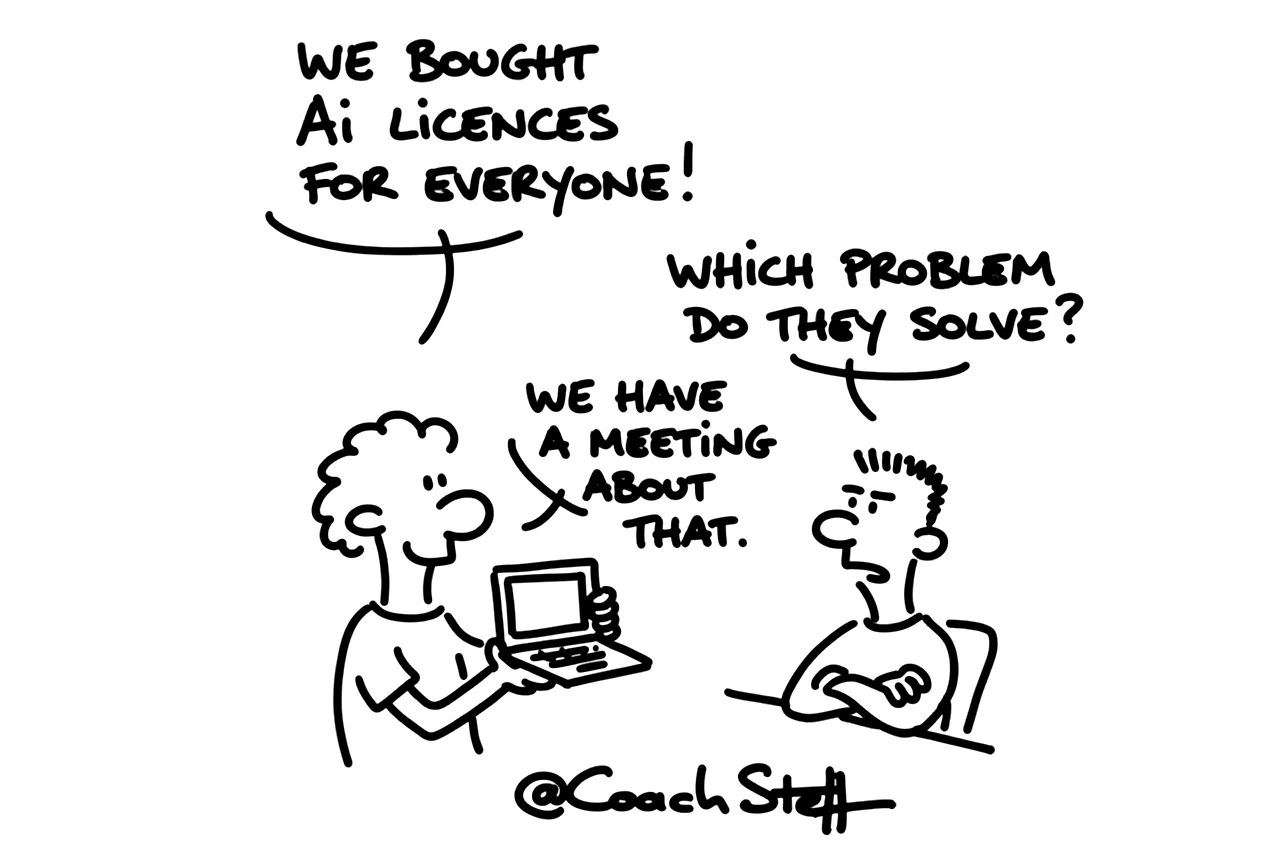
Many people come to a workshop with one big hope. 'We have a subscription to Copilot, so if I learn that tool, it will solve my problem.' I understand that hope very well. You pay for it, your colleagues are already using it, and you finally want to do something with it. But that is not really how it works. You are skipping a step, and that is the step where you think first.
I talked about this with Tom Verheyden in the second episode of our podcast AI HEARTBEAT.md. Tom shared a classification there that I gladly pass on. According to him, AI can bring value on three layers: automating, upgrading and innovating. The longer you look at your own ideas, the clearer it becomes which layer they are in. And that layer actually determines how difficult it will be.
Copy the prompt at the bottom of this article. You can use it to place your own ideas alongside those three layers.
First write down what costs you time
Before you open a tool, I would ask a question that has little to do with technology. Where do you put a lot of time and attention, while it yields nothing for anyone? I mean work that actually does not benefit you, your clients or your colleagues. It has to be done, but nobody is better off for it.
Tom has people write that down on a piece of paper first in his workshops, with the computer put aside for a moment. For me, it works better to talk about it. What works for you does not matter that much. Your thought just needs to be somewhere before you start building. Because building has become very easy today, and that is also the biggest pitfall. You enthusiastically build something that might not have the most value for you or for your company.
Three layers, from easy to difficult
The first layer is automating. It is the same task with the same outcome, only you no longer do it. A system does it. You know perfectly what is good, because you have been doing it yourself for years.
The second layer Tom calls upgrading. That is about work that is only half done today, because the volume is simply not feasible. You probably know it: 'we do not have enough people for that'. An AI does not get tired and you can scale it up quickly. So you can suddenly handle a volume that you previously had to leave behind. Here too you have a good definition of what is good, only on a larger scale.
The third layer is innovating. That is something that was completely impossible before and that only works with AI. It is a bit ironic, because that is the layer everyone prefers to start with immediately. And yet it is the most difficult, because you do not have a definition of good for it yet. You have an assumption, an abstraction of what good could be. You also do not know the effects yet. So it often happens that the AI does not bring the value you expected.
Frequently asked questions
Keep reading for free
Register free with your e-mail address and read on. Your account opens the free articles in the learning space; the rest is for subscribers, from Learn Plus up.
Check your inbox
0 likesNo comments yetRead the comments
Comments
Members comment here and read each other's comments. Register for free or sign in to join the conversation.
Register for free or sign inNo comments yet. What do you take away?