

This page was translated from Dutch with AI.
Who decides at each fork in your workflow?
You want to automate a piece of your work and you draw out the steps. Mail comes in, something reads that mail, and then something has to happen. Only, a choice has to be made at that moment too. Is this a real question or is it spam? Is this document an invoice or a contract? In a training course on automation, a participant asked me whether such a workflow is AI or not. A good question, because you probably also feel yourself that it has to be one or the other.
The answer is actually: both, and different for each fork. And the better you see those forks, the easier your workflow becomes to build.
Copy the prompt at the bottom of this article. With it, you and your AI can list every fork in your own process.
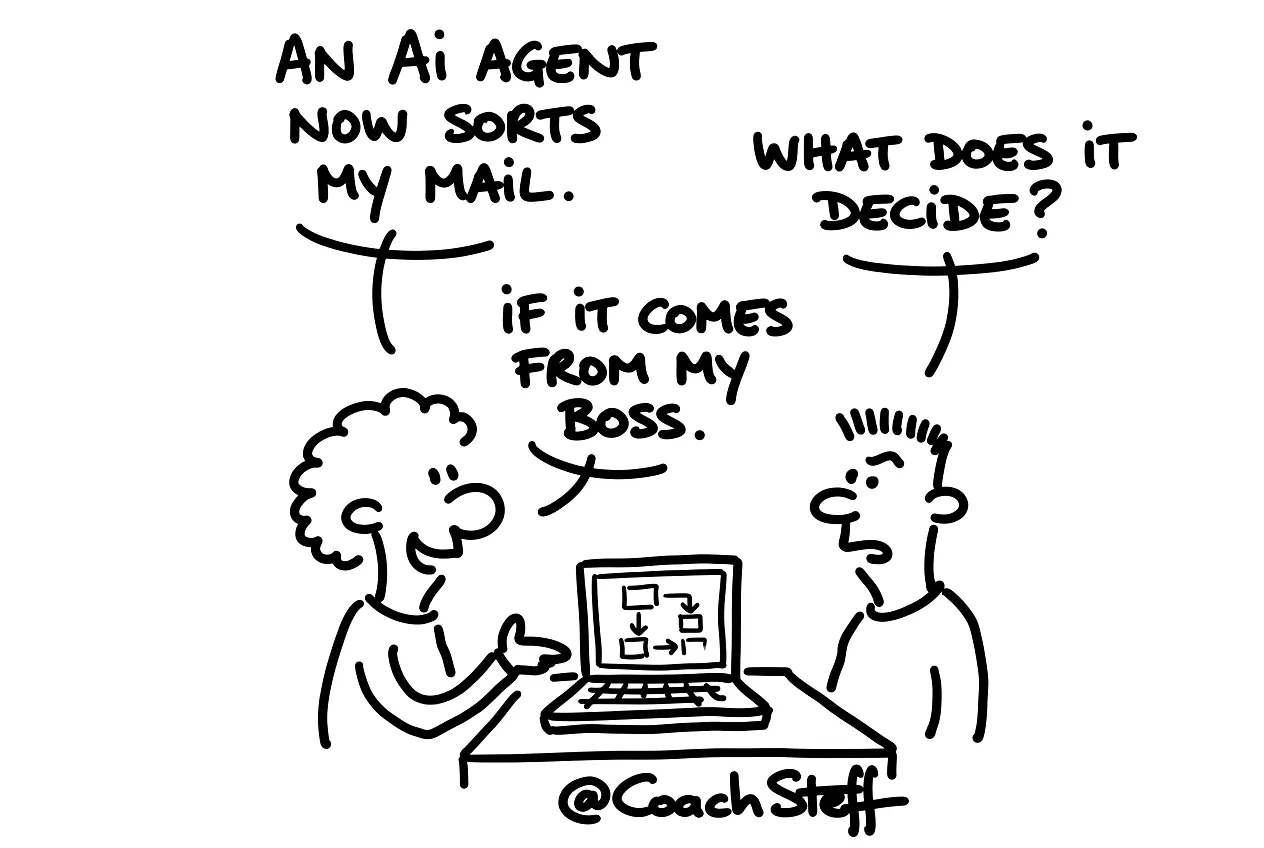
A fork in your workflow is called a decision gate
A decision gate is the point where your workflow chooses which way to go. I always show a simple example of this in n8n in my workshops. A new mail comes in. An agent reads that mail. And then comes the fork: is this a real question from a human, or is it spam or something else? If it is not real, nothing happens. If it is a real question, the workflow prepares a draft in the drafts folder of my Gmail. I check it and I send it myself.
That seems like a small detail. Yet that is where the question lies that most people skip over too quickly. Who or what decides at that fork? That does not have to be the same everywhere. There can be AI in every node of your workflow, but there does not have to be.
Four ways to decide
The oldest is the logic gate. If this, then that, otherwise something else. That is what we have seen in software for decades. If the mail comes from a fixed address, or if there is a specific word in the subject, such a rule is sufficient. It costs nothing and it never doubts.
Besides that, you now have the agentic decision gate. Then you let a language model decide, a Claude, a ChatGPT or a Gemini. That is handy when the input is different every time. A mail from a customer who is angry but never literally says so, will not be recognised by a rule. An agent will.
And then there is something new: models that are specially made to decide. Suppose you have a folder with many different types of documents, which all need to be read and neatly organised. You can have a classic language model do that, but that costs you a lot of tokens. A model that only decides does the same sorting work much faster and much more economically. For such a pile, that is actually the logical choice.
You might forget the fourth one, and that is you. The human is still in the story, and you can be a decision gate yourself. In my example, I decide myself whether the draft leaves. I would keep that role wherever something is irreversible, goes outside, or where you need a mandate.
Frequently asked questions
Keep reading for free
Register free with your e-mail address and read on. Your account opens the free articles in the learning space; the rest is for subscribers, from Learn Plus up.
Check your inbox
0 likesNo comments yetRead the comments
Comments
Members comment here and read each other's comments. Register for free or sign in to join the conversation.
Register for free or sign inNo comments yet. What do you take away?