

This page was translated from Dutch with AI.
Am I allowed to do this with AI? The AI Act as a quick check
You have an idea to use AI in your work. Having a report of a conversation written out, processing CVs, a chatbot for your customers. And then the doubt sets in. Is that actually allowed? How far can I go? You are certainly not the only one. I get that question in almost every training, and usually with a worried look.
I would say: you need to be aware of it, but you should not completely freak out about it either. There is a fairly simple framework that helps you to categorise your use case. That is the European AI Act, which classifies AI according to risk. As you run your own idea through those boxes, you will notice that much of your doubt disappears on its own.
At the bottom of this article you will find a prompt that lets you categorise your own use case. Feel free to copy it.
Four boxes, from green to banned
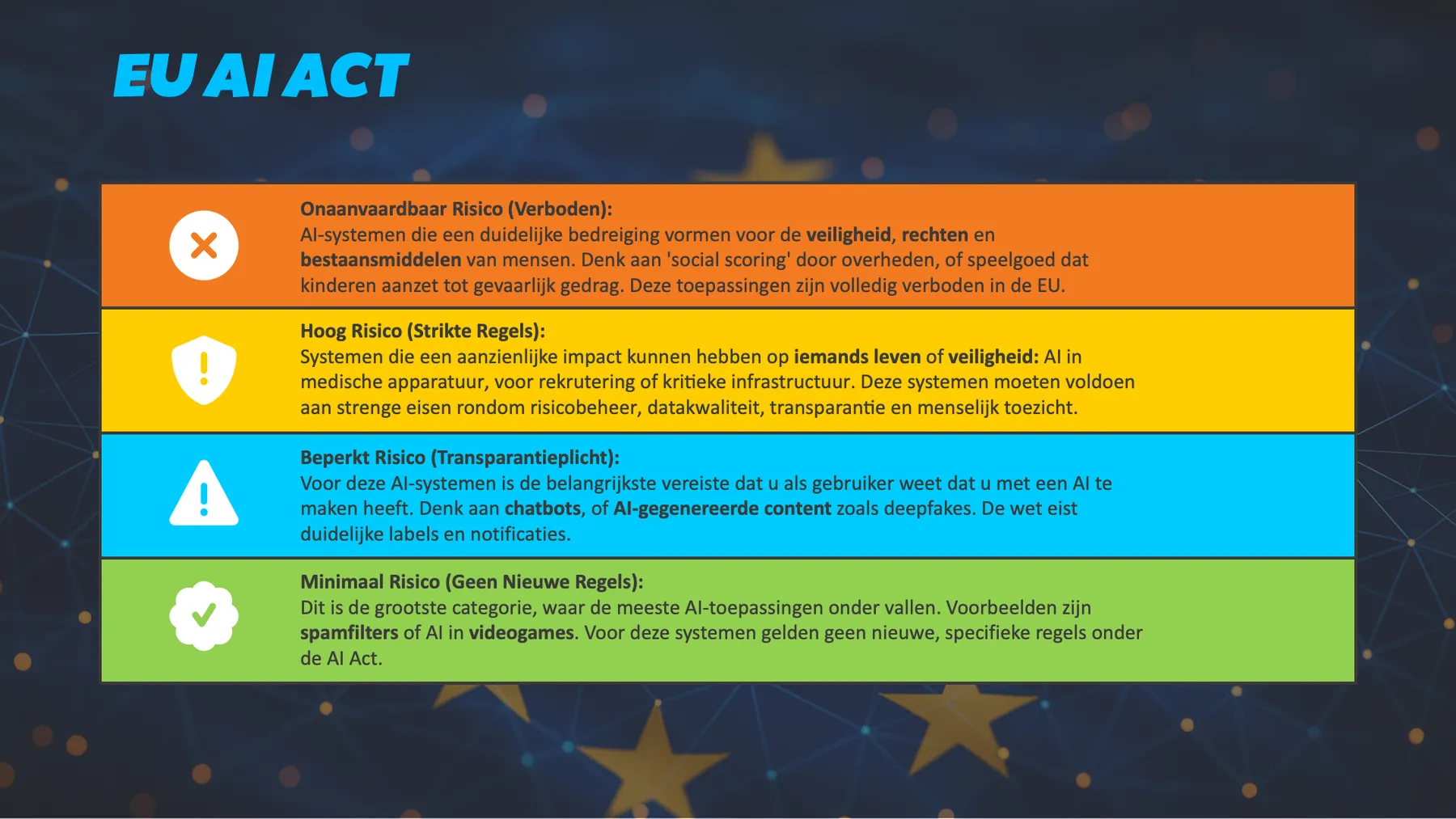
The AI Act mainly looks at what you do with AI. And then you end up in one of four boxes.
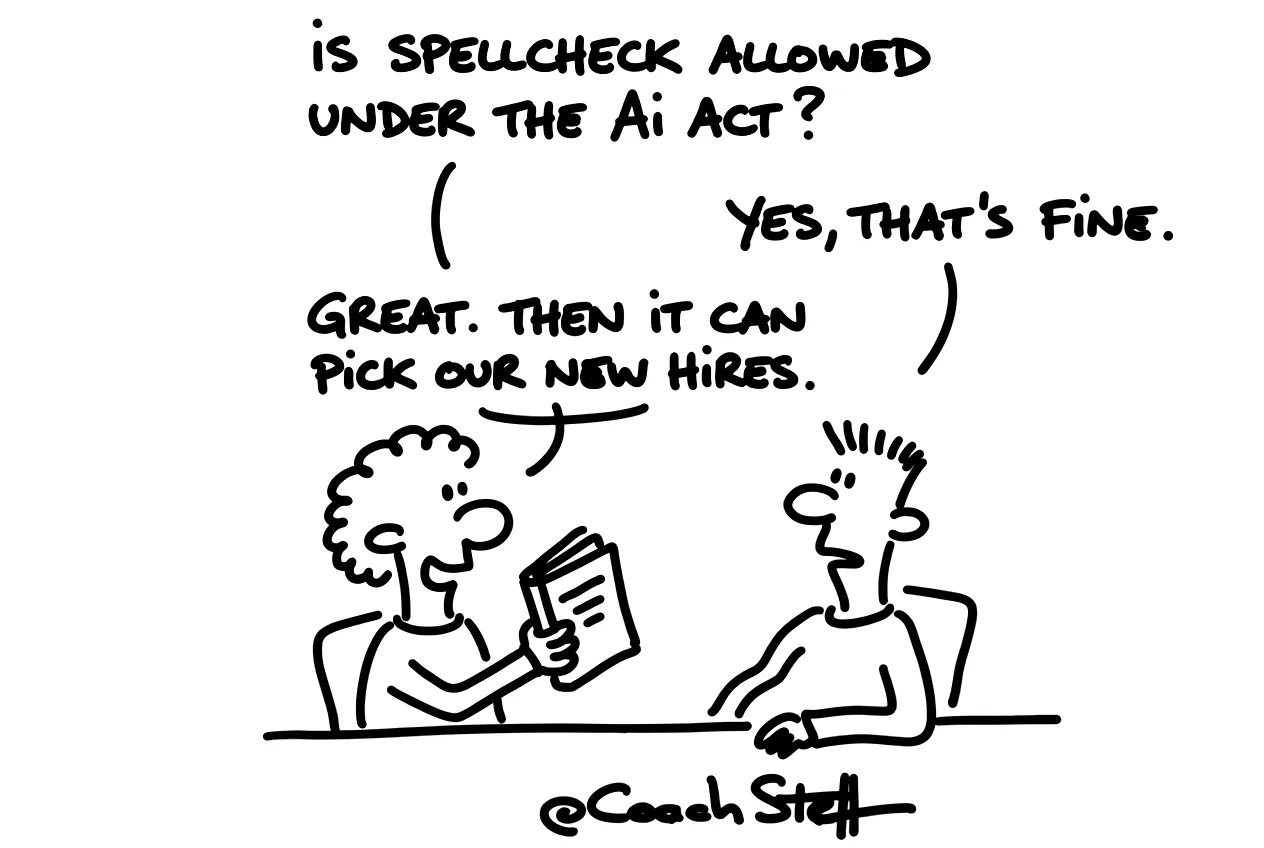
The first box is minimal risk. That contains everything you do not actually even see: the autocorrect on your phone, the spell checker in your text. That is green. You do not have to think about that.
The second box is limited risk. That contains the regular chatbots, including internal ones, and content you create with AI. The rule there is mainly transparency. Anyone talking to a chatbot must know it is a chatbot. And an image created with AI must be recognisable as AI. The major tools put that in the metadata today, and sometimes even invisibly in the image itself. You actually already know metadata. A photo from your mobile phone also saves where and with which device it was taken.
The third box is high risk. This is about AI that can have an impact on someone's life, health, safety or career. Think of medical devices, or systems that decide who gets a job or a loan. Such systems must meet strict legal requirements and are audited. A regular chatbot is not made for that.
The fourth box is banned. That contains systems that threaten your safety, your rights or your existence. Social scoring is the best known example: giving people points for their behaviour, right down to the zebra crossing.
Frequently asked questions
Keep reading for free
Register free with your e-mail address and read on. Your account opens the free articles in the learning space; the rest is for subscribers, from Learn Plus up.