

This page was translated from Dutch with AI.
When two people in your meeting refuse to budge
You are in a meeting and the conversation gets stuck on two people. One wants to go left, the other wants to go right, and no one budges. The rest of the table looks at the ceiling. And perhaps you wonder how you will ever reach an agreement here.
In a training course on meetings, that question came up literally. A participant said: 'Sometimes there are meetings where two people are truly diametrically opposed. And they refuse to budge from that position. How do you reach a closing step then?' I think that is a very honest question. Because the model of a meeting that opens up and closes again sounds nice until you experience a moment like that.
Copy the template at the bottom of this article. You can use it to put the two lists from this article on a flip chart or in your minutes.
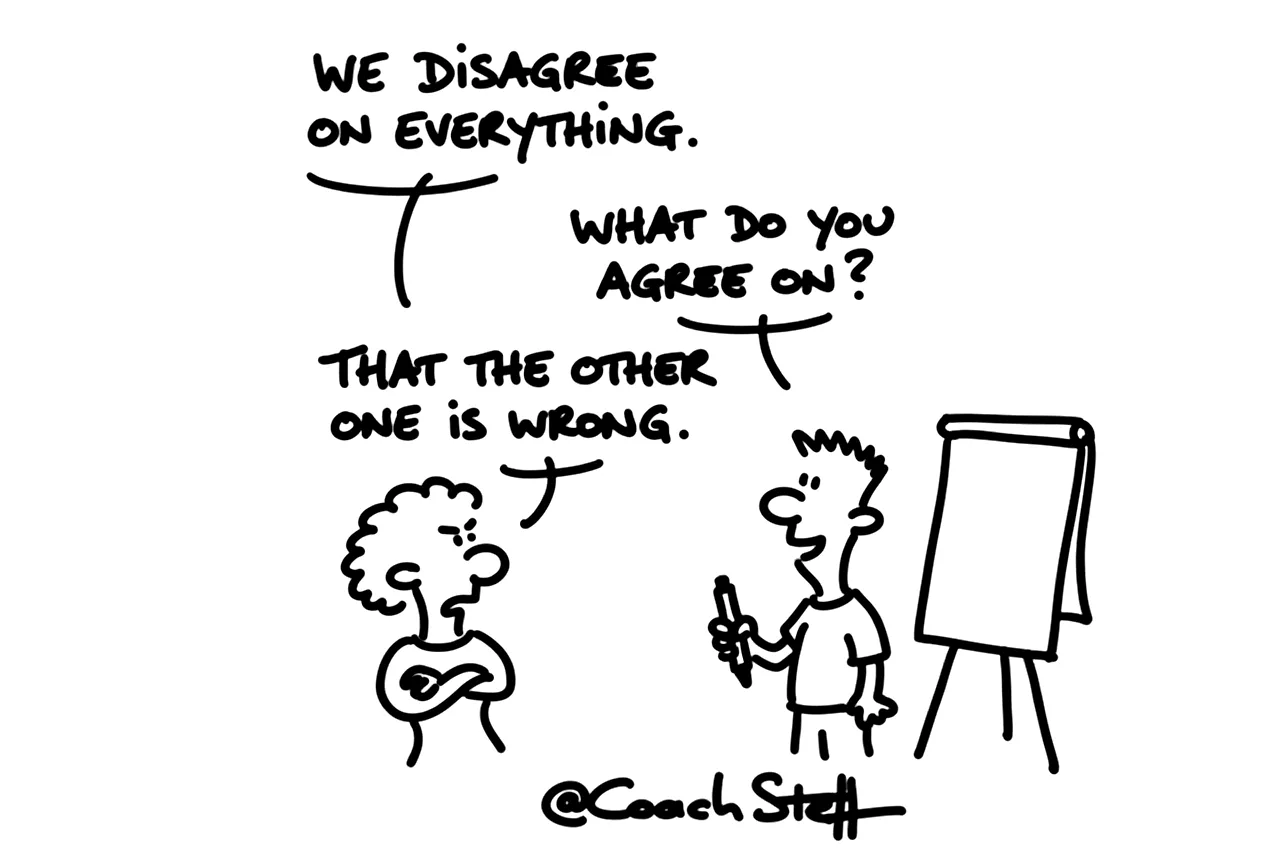
First write down what they disagree on
What I do then is actually explore again. I say: we are going to write down all the points you disagree on. All of them, so that no one feels their point is disappearing. I think that already provides some calm. The difference is then on paper, and no longer just hangs between two people.
After that, I make a second list with the points they do agree on. What goes on it are often higher values. Take a discussion about safety at work. No one wants accidents on the shop floor. And no one wants people to become less productive. No one needs to argue about that.
Build on what is beyond dispute
Those shared values are a foundation. You can build from there. You put the two positions next to it and ask: if we look at those foundations, in what way can we work together? Sometimes a new scenario emerges, or a new way of working that works for both.
That usually requires more thinking than digging your heels in. And the irony is that you only have a conversation like this because the positions are so far apart. I think this sits somewhere between coaching, mediating and facilitating.
Frequently asked questions
Keep reading for free
Register free with your e-mail address and read on. Your account opens the free articles in the learning space; the rest is for subscribers, from Learn Plus up.
Check your inbox
0 likesNo comments yetRead the comments
Comments
Members comment here and read each other's comments. Register for free or sign in to join the conversation.
Register for free or sign inNo comments yet. What do you take away?