

This page was translated from Dutch with AI.
Your SWOT only starts after the four lists
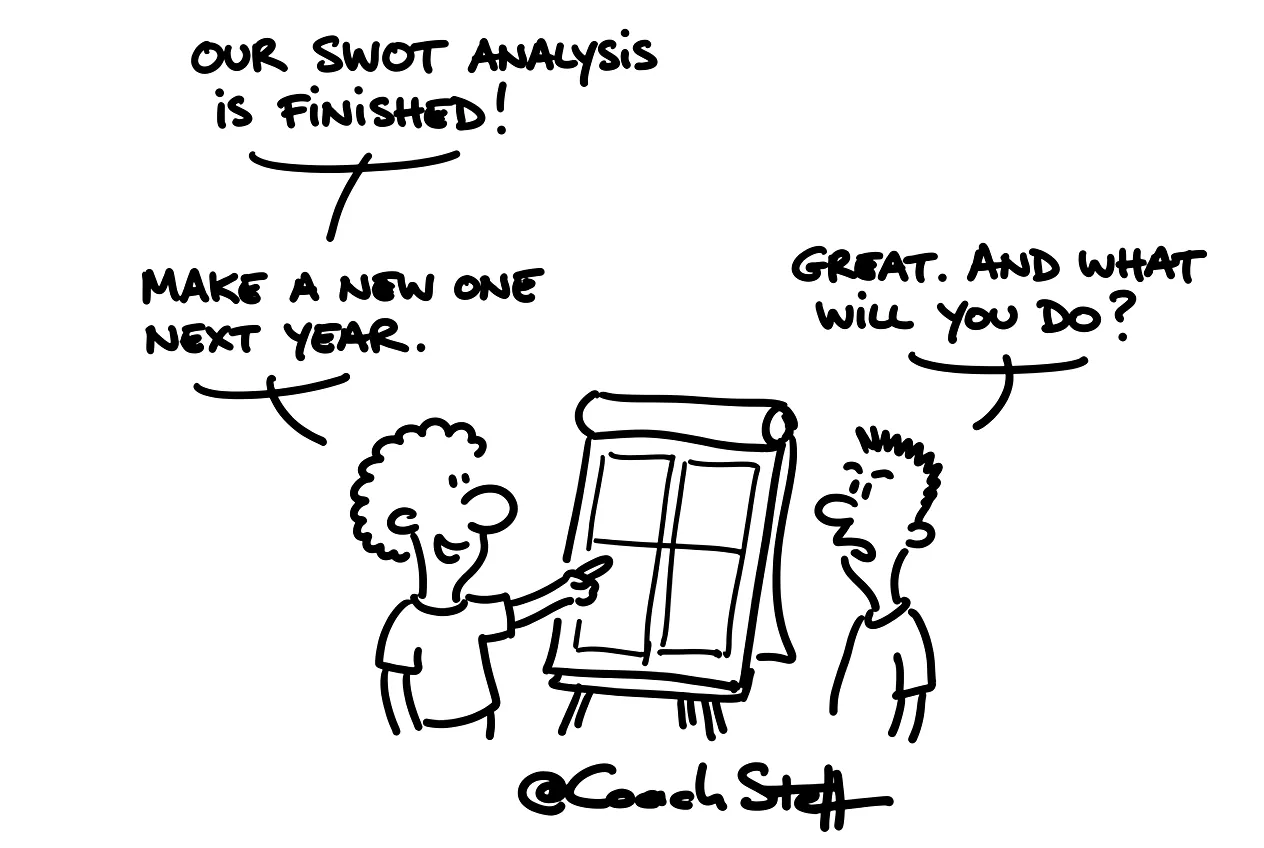
Four sheets on the wall, or four columns in a document. Strengths, weaknesses, opportunities and threats, neatly filled in with post-its in four colours. You might have spent a whole afternoon on it, together with your team. And yet, afterwards, you do not really know what to do with it. It feels like finished work, but nobody knows what needs to change on Monday.
In a training course on strategic thinking, I asked who already knew the SWOT analysis. A few participants had already worked with it. What most people call a SWOT is actually just the first step. I see people say that their four lists are ready, and then they stop. After that, the real exercise begins, and it is called the confrontation matrix.
Copy the prompt at the bottom of this article. With it, you let your AI guide you through the confrontation matrix, with yourself at the wheel.
What is in your four lists
First, let us set the scene. Strengths and weaknesses are your internal analysis. Those are things that lie within your circle of control. You are good at summarising, you are good at presenting, or you might have a blind spot. That can be about yourself, about your team or about your entire organisation.
Opportunities and threats come from the outside. A technological evolution, or something you see happening in the market. You have no hand in that yourself, but it is coming your way.
Making those lists is actually not that difficult. You just have to look for your sources and your data, and then you write down what you see. It is also the least challenging part of the whole exercise. Yet that is exactly the part where most people spend their afternoon.
How to put the lists against each other
In the confrontation matrix, you will weigh your internal and external factors against each other. I would first make a top three per category. That keeps it manageable. Then you ask the same question for each combination. To what extent does this strength help us to seize that opportunity? And to what extent does this weakness hold us back?
You give each combination a score on a scale from minus two to plus two, like in a survey. Zero is neutral. Plus two is a strongly desired effect, minus two a strongly undesired effect. I put those scores in an Excel myself and give them a colour, because then you immediately see where it gets warm. When you do that for the first time, you will notice that some combinations are immediately clear and others are not at all.
Frequently asked questions
Keep reading for free
Register free with your e-mail address and read on. Your account opens the free articles in the learning space; the rest is for subscribers, from Learn Plus up.
Check your inbox
0 likesNo comments yetRead the comments
Comments
Members comment here and read each other's comments. Register for free or sign in to join the conversation.
Register for free or sign inNo comments yet. What do you take away?