

This page was translated from Dutch with AI.
Separate your handout from your slides
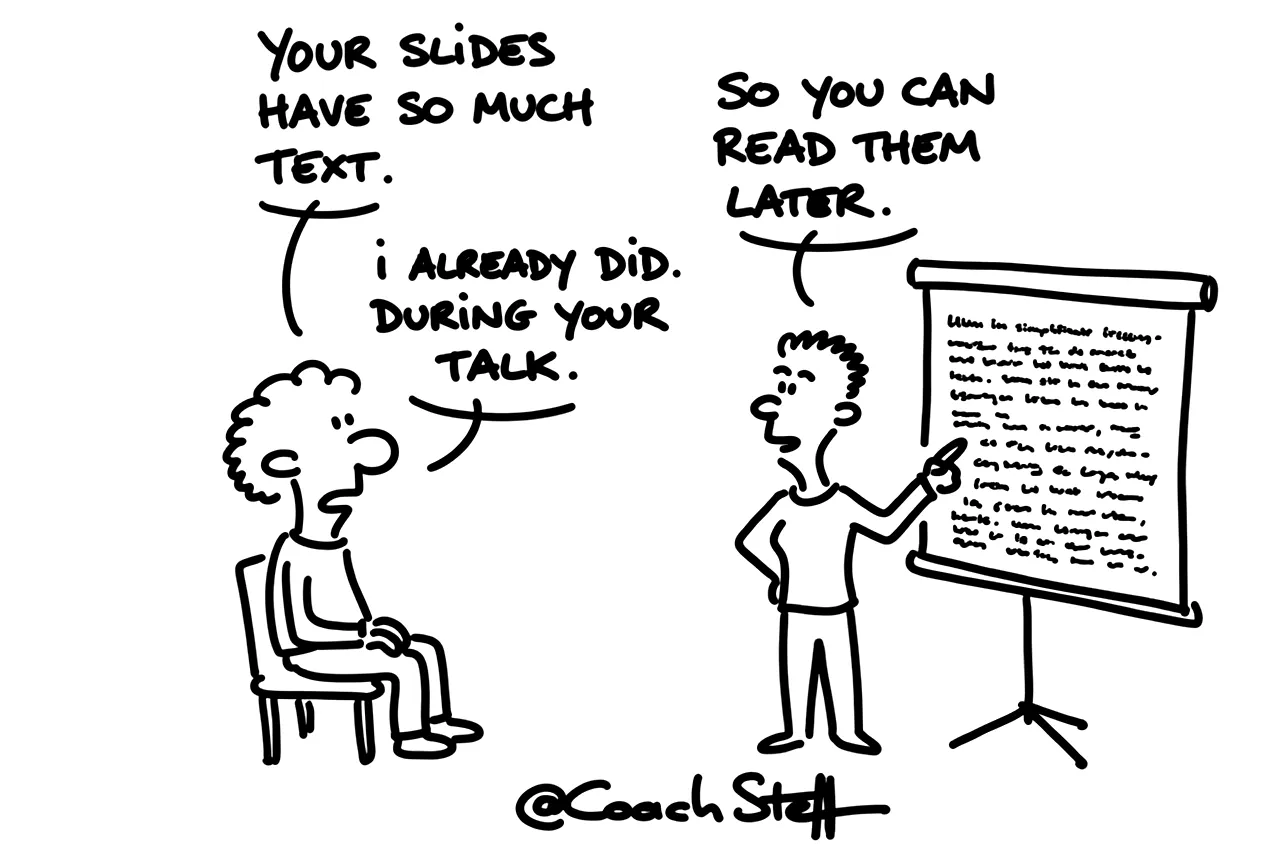
How much text is on the slides of your last presentation? If it is a lot, you are certainly not the only one. You want people to still get something out of it afterwards. So you put everything you could possibly say on your slides, so you can send them out after the meeting. And then something happens that you might recognise. Everyone reads along on the screen, faster than you talk. By the third slide, no one is really listening anymore.
In a training course on meetings, a participant asked how to handle this in a real training session, where you do have to provide explanations. That is a fair question. I would make it two separate things. Slides for during your presentation, and a handout for afterwards.
Copy the prompt at the bottom of this article. With it, you can turn a full presentation into calm slides and a separate handout.
What people need during your presentation
The temptation is always there to put everything on a slide. You are starting from yourself then. You think of everything you want to tell, and all of that has to go on there. I would start from the people in the room. What do they need to follow you? I think that is a few anchor points and a story. A graph can be such an anchor point. You show it, and then you tell the story around it.
Images help with that too. An icon, a photo, a diagram, it all comes down to the same thing. People see something and you talk about it. And that sticks much better than a text they can read off themselves.
It is actually a bit ironic. You put everything on your slides so people can read it later. And precisely because of that, they are already reading it during your presentation, while you are still speaking. In that training course, a participant noted that we had been going for a solid hour and were only on slide five. That was correct. There was also almost nothing on my slides, and so the conversation was about what we were saying to each other.
The title already tells half your story
What do you put on them then? Look at the slides of large consultancy firms. There is not that much on them, only the essence. And the title is often the summary of the slide. On one of my slides about meetings, the title is 'Keep time under control'. Below that are the five elements that go with it, and nothing else. So anyone who only reads the titles already knows the main outline of your story.
You can actually just ask your AI. Ask what good practices exist for slides, and you will get roughly the same answer every time. The more you leave out, the more room is left for the conversation in the room.
Frequently asked questions
Keep reading for free
Register free with your e-mail address and read on. Your account opens the free articles in the learning space; the rest is for subscribers, from Learn Plus up.
Check your inbox
0 likesNo comments yetRead the comments
Comments
Members comment here and read each other's comments. Register for free or sign in to join the conversation.
Register for free or sign inNo comments yet. What do you take away?